
Tankless Water Heater Flushing and Maintenance in Richmond, VA
Flushing, also called descaling, is the most important maintenance a tankless water heater needs, and Richmond-area homes are no exception. Minerals in the water slowly build up inside the unit and cut its performance.
How often to flush
Many manufacturers recommend flushing at least once a year. Homes with harder water, including many on private wells, may need it more often. Your owner's manual gives the schedule for your model, and some units display a maintenance reminder.
What a maintenance visit covers
- Flushing the heat exchanger with a descaling solution through the service valves.
- Cleaning the water inlet filter.
- Checking the venting and air intake.
- Checking the condensate drain on condensing units.
- Looking for leaks at the gas and water connections.
- Reviewing the unit's error history.
No service valves?
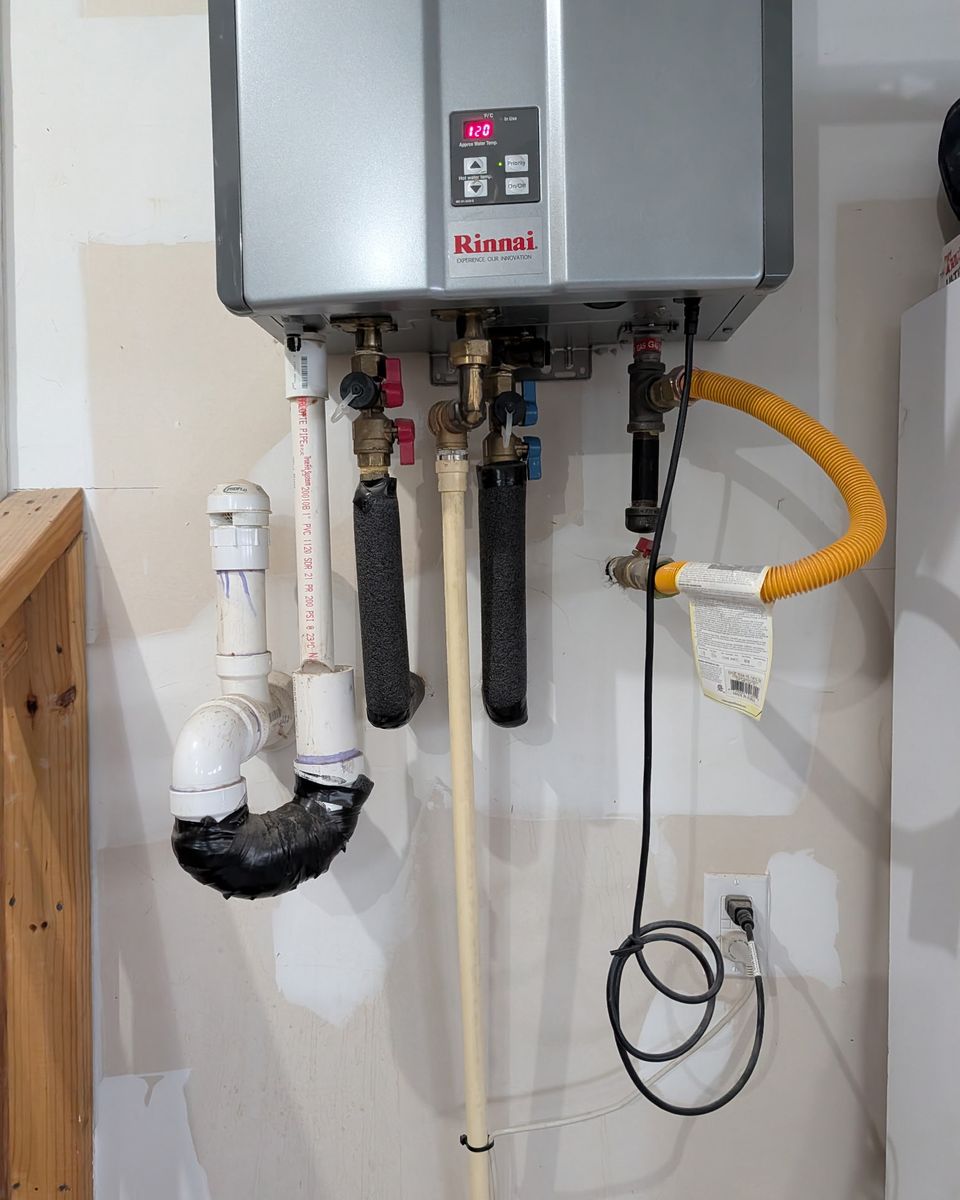
Flushing is done through service valves on the water lines, like the ones in the photo above. If your unit was installed without them, a contractor can usually add them, and it is worth doing before the first flush. See service valves on real installs.
Can I flush it myself?
Many homeowners do, using a small pump and a descaling solution through the service valves and following the owner's manual. If you'd rather not, have a contractor do it. Damage caused by scale buildup is often excluded from warranties, so keeping up with flushing protects your coverage either way.
How hard is Richmond-area water?
Scale comes from minerals in the water, so hardness sets how fast it builds up. Most public water around Richmond is on the soft side:
- Chesterfield County: the county describes its water as naturally soft, about 40 to 70 parts per million, or 2 to 4 grains per gallon. It comes from the James River, Lake Chesdin, and the Swift Creek Reservoir.
- City of Richmond: drawn from the James River, with hardness listed at 64 parts per million in the city's 2019 water quality report.
- Henrico County: also drawn from the James River. The county's annual water quality report, or a call to the utility, will give you current figures.
- Private wells: common in the area's rural counties, and often much harder than public water. Have yours tested.
Softer water means scale builds more slowly, but it still builds. Follow your manufacturer's flushing schedule.
Signs your unit needs a flush
- Hot water flow is weaker than it used to be.
- The temperature swings or won't hold steady.
- The unit shows a scale or low-flow code, such as LC on many Rinnai units.
- It's been more than a year since the last flush.
What a do-it-yourself flush involves
Your owner's manual has the exact steps for your model, but a typical flush goes like this:
- Turn off power to the unit, close the water valves at the unit, and shut off the gas supply if your manual says to.
- Connect a small pump and hoses to the service valves, with a bucket of descaling solution.
- Circulate the solution through the heat exchanger, often for about an hour.
- Rinse with fresh water, then clean the inlet filter.
- Reopen the valves, restore power and gas, and check for leaks.
Many manuals allow food-grade white vinegar or a manufacturer-approved descaler. Use only what your manual allows.
Other maintenance worth doing
- Clean the water inlet filter, which can clog between flushes.
- Keep the air intake and vent openings outside clear of leaves, snow, and nests.
- On condensing units, make sure the condensate drain flows, and replace any neutralizer media on the schedule the manufacturer recommends.
- Look for drips at the gas and water connections.
If flushing doesn't restore the flow, or error codes keep coming back, the cause may be a failed part or something in the original installation. See common problems and repairs.
Maintenance questions
How long does a flush take?
Often about an hour of circulating the solution, plus time to set up and rinse.
Do I need a water softener for a tankless unit in Richmond?
On most public water in the area, which is on the soft side, many homeowners don't. On a hard well, a softener or scale-reduction system can cut down on flushing and protect the unit. A water test tells you which situation you're in.
Can skipping flushes affect my warranty?
It can. Damage from scale is often excluded, and some manufacturers expect proof of maintenance. Keep receipts or a simple log of each flush.
Does a condensing unit need different maintenance?
It needs the same flushing, plus attention to the condensate drain and neutralizer, since condensing units produce slightly acidic water.
How we help
Call or send a short request and tell us about your home. We connect you with one independent, licensed contractor who serves your area. They evaluate your home and give you a quote, and you decide. There's no charge for the referral.
Want a licensed contractor to look at your home?
Call or send a short request. There's no charge for the referral.