
Propane Tankless Water Heaters in the Richmond Area
Lots of Richmond-area homes have no natural gas line and run on propane, from houses past the end of the gas lines to whole subdivisions built without them. Hallsley, in Midlothian, is one of those subdivisions: its homes came with a 500-gallon tank buried in the yard and a tankless water heater. Here's what to know about living with that setup, and about putting in a tank of your own.
Propane company or plumber?
A propane home has two service relationships. The propane company is responsible for the tank, the regulators and the deliveries, and it's normally the one that sets a new tank. A plumbing or gas contractor takes care of the water heater, its vent, and the gas piping inside the house. The water heater side is the job of one independent local contractor; propane sales and tank setting stay with the propane company.
What's out in the yard
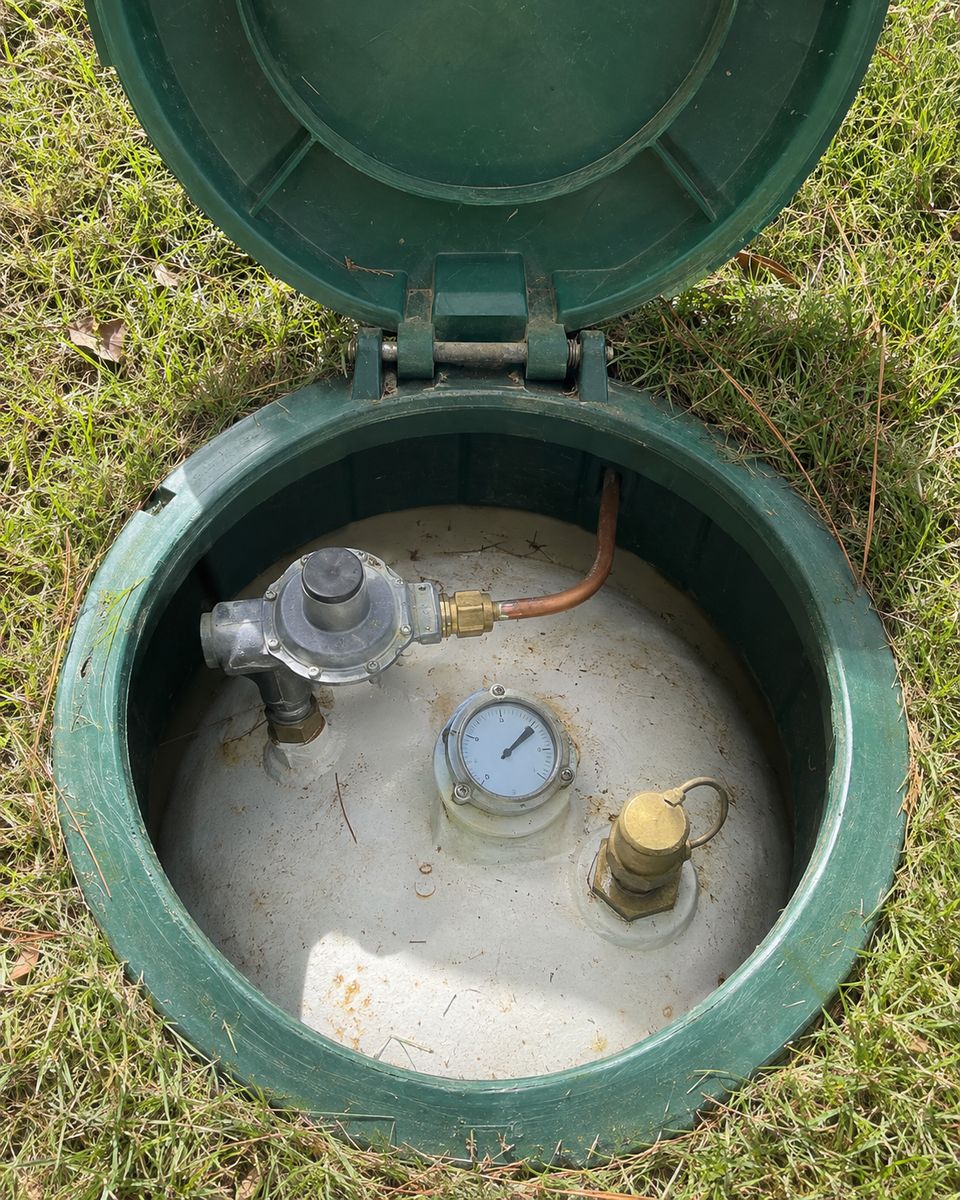
- The tank. Either it sits above ground, or it's buried and only a dome-shaped lid shows, a few inches above the grass. The gauge and the fill valve are under that lid.
- The gauge. It reads in percent of the tank's size. A reading of 50% on a 500-gallon tank means about 250 gallons are in it.
- The fill limit. Tanks are filled to about 80%, never full, so the liquid has room to expand in summer heat. A 500-gallon tank takes about 400 gallons of propane.
- Corrosion protection. A buried steel tank relies on a coating and cathodic protection, typically a magnesium or zinc anode wired to it that corrodes so the tank doesn't. The propane code has required it on underground tanks installed since 2011, along with periodic testing.
- One supply for the whole house. The water heater shares the tank with the furnace, cooktop, fireplace or generator if those run on propane too.
Don't let it run dry
Propane companies typically offer scheduled deliveries, based on your past use or a remote tank monitor, or delivery when you call. If you're on will-call, put the gauge on your calendar in winter.
An empty tank is more than an empty tank. The National Fuel Gas Code (NFPA 54) requires the piping to be checked for leaks when gas comes back on after an interruption. So running out means waiting for that check, as well as the delivery, before the water heater fires again.
How far a tank goes on hot water alone
A worked example, using about 91,500 BTU per gallon of propane (U.S. Energy Information Administration) and the Department of Energy's planning figure of 50°F incoming water, heated to 120°F:
- Say the household uses 40 gallons of hot water a day. Heating it 70 degrees takes 40 × 8.3 pounds × 70 ≈ 23,200 BTU.
- At an assumed 95% efficiency, the unit burns about 24,500 BTU of propane, or about 0.27 gallon a day.
- That's roughly 8 gallons a month, or close to 100 gallons a year, for water heating alone.
- At full fire, a 199,000 BTU-per-hour unit burns about 2.2 gallons an hour, so the tank and regulator have to deliver gas fast as well as last.
Your own numbers will differ. The propane company's delivery records show what your house really uses, including the furnace in winter.
When the propane unit needs work
- Check the gauge before you blame the heater. A low tank, or a regulator problem, can look like a water heater fault.
- Match the fuel. A replacement must be built for propane or converted with the maker's own kit where the manual permits. Never run a natural gas unit on propane as-is.
- Mind the gas input. Moving up to a unit with a higher BTU rating means the regulator and piping have to carry more. Bring the propane company in before the swap.
- Expect a permit. Virginia's building code exempts some appliance replacements from permits, but only equipment "not fueled by gas or oil," so replacing a propane water heater needs one. In Chesterfield County, the 2026-27 fee for a like-for-like gas appliance replacement, natural gas or propane, is $57.
Who's allowed to fill your tank
Virginia Code § 18.2-494 lets only a propane container's owner, or someone the owner authorizes in writing, fill it. In practice:
- If you lease the tank, the company that owns it is your supplier. Its name or mark is usually on the tank.
- If you own the tank, you can shop around for propane.
- In a qualifying emergency, such as a declared state of emergency or dangerous severe weather when a home can't get enough propane for heat, a residential customer with less than a 24-hour supply who has first asked the owner for a delivery may have another company fill a leased tank if the owner can't deliver within 24 hours.
Putting in a new tank
Maybe your house is all-electric and you want a gas tankless unit, or you'd rather bury the tank that sits beside the house now. NFPA 58, the national code for propane storage, sets the minimums. Your HOA, if you have one, can add its own rules on top.
- Buried. Only the lid shows. A tank up to 2,000 gallons goes at least 10 feet from the house and from property lines. It needs at least 6 inches of soil over it, or 18 inches within 10 feet of a driveway or parking area, and it can't sit where vehicles drive over it. Digging usually makes it cost more to install.
- Above ground. A 125- to 500-gallon tank also goes at least 10 feet from the house and property lines. It's usually cheaper to set, but you'll see it, and an HOA may ask you to screen it.
- Either way, the relief valve and fill connection on a tank filled in place need 10 feet of clearance from outside sources of ignition.

The order of operations
- HOA approval, in writing. Ask the architectural committee whether a tank has to be buried or screened before you commit to anything.
- Choose a propane company and decide lease or buy. The company usually installs the tank and regulators.
- Pick the spot together. It has to meet the distances above and be reachable from the delivery truck's hose.
- Permit. The tank, the line and the piping to the appliances fall under your county's building permits. Chesterfield's 2026-27 schedule, for example, charges $114 for a propane tank and/or line plus gas piping to appliances, or $57 for the tank and/or line alone, plus a 2% state levy.
- Contact Virginia 811. The locate request is free and required by Virginia law before digging. Utilities have until 7 a.m. on the third working day to respond. Dig only after Virginia 811's Positive Response System shows every utility has marked its lines or reported none. Private lines aren't marked by the utilities, so the owner has to locate those.
- The water heater work. The contractor runs the inside gas piping, installs and vents the tankless unit, and schedules the inspection.
Propane tankless questions
How do I tell whether my tank is leased?
Look for a company name or mark on the tank or the lid, and ask the company that delivers your propane. If you bought the tank, you should have a bill of sale. Virginia's propane-container law treats whoever holds a written bill of sale as the tank's owner.
Can a buried tank be moved or swapped for an above-ground one?
Yes, but it's the propane company's job, and the new spot has to meet the same distance rules. Check with your HOA before a tank goes from hidden to visible.
If natural gas reaches my street later, can my propane unit switch?
Some models can, with the manufacturer's conversion kit installed by a qualified technician. Others are built for one fuel only. The unit's manual says which.
Does a propane tankless unit work without power?
No. A full tank won't help, because the unit needs electricity for its controls, fan and ignition. A generator or battery backup that covers the water heater's outlet will.
What happens next
Call or send a short request about your propane water heater. One independent contractor who serves your area looks at the job and quotes it. You decide.
Related pages
Sources
- Code of Virginia § 18.2-494 and § 18.2-493, filling propane containers and who counts as the owner
- Code of Virginia § 56-265.17 and Virginia 811, locate requests before digging
- 13VAC5-63-80, Virginia building code permit requirements and exemptions
- Propane Education & Research Council, NFPA 58 tank placement (archived)
- Superior Plus Propane: underground tanks, tank capacities, the 80% fill and reading the gauge
- N.C. Department of Agriculture, cathodic protection for underground propane tanks
- Chesterfield County residential fee schedule
- U.S. Energy Information Administration, BTU conversion factors
- U.S. Department of Energy, sizing a new water heater
- Oil & Energy, NFPA 54 leak check after an interruption
Propane water heater acting up?
Call or send a short request.