
Converting a Tank Water Heater to Tankless in Richmond, VA
Thinking about converting from a tank to a tankless water heater in your Richmond-area home? A conversion is a bigger job than swapping one tank for another. Here's what changes, where the gas company and the county come in, and how to tell whether it's worth it for your house.
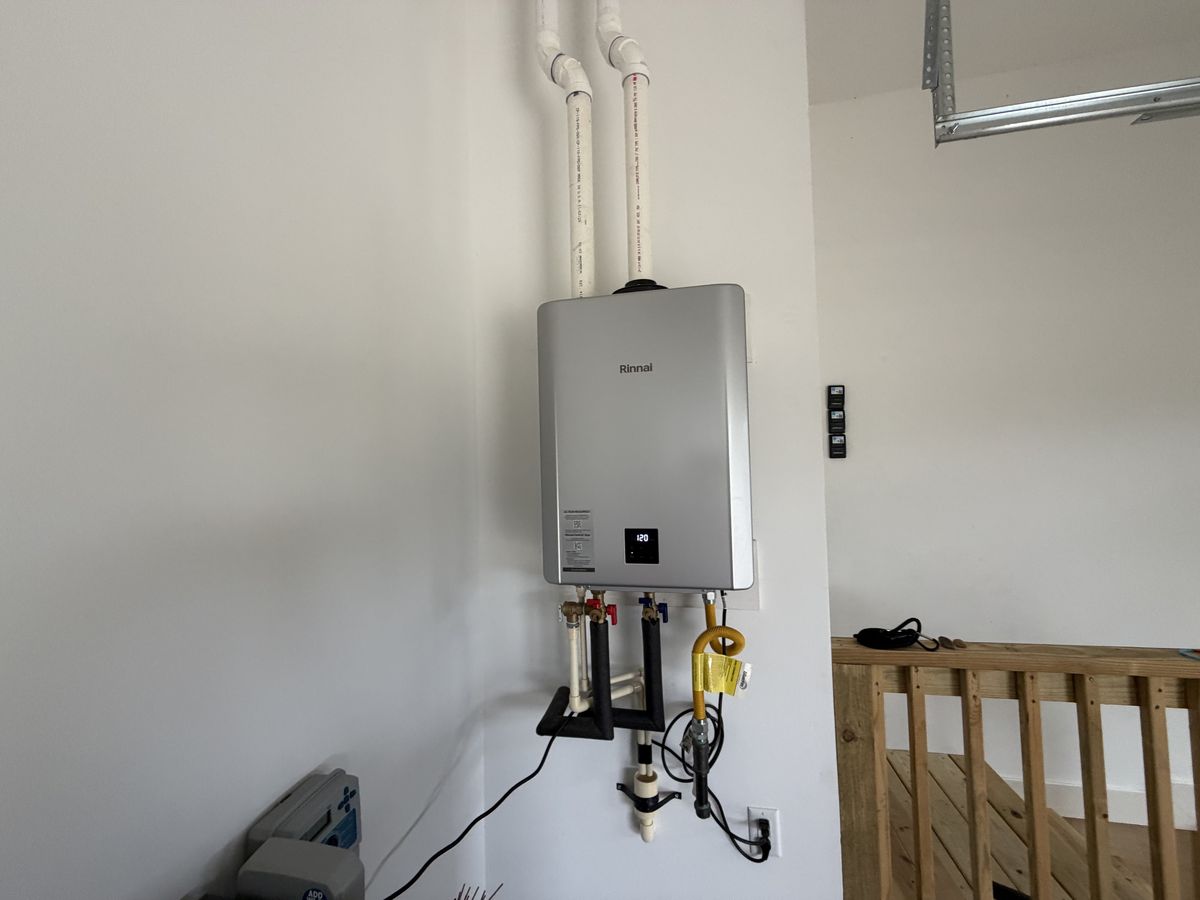
Is converting worth it?
The U.S. Department of Energy says tankless water heaters can be 24% to 34% more energy efficient than storage tanks in homes that use 41 gallons of hot water a day or less, and 8% to 14% more efficient in homes that use a lot, around 86 gallons a day. DOE also says most tankless units last more than 20 years, while storage tanks last 10 to 15.
The tradeoffs are a higher upfront cost, a limit on how much hot water flows at once, and periodic flushing. If your home would need major gas, venting, or electrical work, or your household runs a lot of hot water at the same time, another tank can be the smarter move. See both sides.
What changes in a tank-to-tankless conversion
- The gas line. A typical gas tank's burner uses about 30,000 to 50,000 BTU per hour. A whole-home tankless unit uses about 120,000 to 200,000 BTU per hour at full output, so the gas line inside the house is often upsized.
- The gas meter. The meter has to handle every gas appliance running together. Sometimes the utility has to upgrade it or the service line.
- The vent. Rinnai and Navien both say not to tie a tankless unit into an existing vent, chimney or shared vent stack, so a conversion usually gets new venting. Condensing units vent through solid-core plastic pipe.
- A condensate drain for condensing units, often with a neutralizer.
- A grounded 120-volt outlet near the unit. Rinnai's manual, for one, says not to use an extension cord.
- Wall mounting with service clearance. Rinnai, for example, asks for 24 inches in front of the unit.
- Service valves so the unit can be shut off from the house plumbing and flushed.
- Removal and disposal of the old tank.
If the old tank shared a chimney with your furnace
In some homes, the gas water heater and the gas furnace vent into the same chimney. When the tank comes out, the furnace is left venting alone into a flue that was sized for both. The Department of Energy's guidance says to have the installing contractor test the furnace's draft after the water heater is removed from a shared flue. Ask about this before the job, not after.
Where the gas company comes in
Richmond Gas Works, run by the City of Richmond's Department of Public Utilities, serves the city, Henrico County, and portions of Chesterfield and Hanover. When you add gas appliances, it asks for the BTU load of each existing and new appliance so it can size the meter correctly. Columbia Gas of Virginia serves other parts of suburban Richmond and offers meter and service line upgrades when a home adds gas usage. If your home runs on propane, loop in your propane supplier, since the tank and regulator have to keep up with a high-demand appliance.
A meter upgrade can add lead time, so a good contractor checks the gas load early. More on gas installs.
Rebates and tax credits
If Columbia Gas of Virginia is your gas company, its 2026 WarmWise program lists rebates on efficient tankless water heaters: $150 for a unit rated at least 0.92 UEF, and $250 for at least 0.95 UEF. The program covers replacements in existing homes, not new construction. The unit has to be bought and installed in 2026, and the application is due within 120 days or by January 31, 2027, whichever comes first. Funding is limited, so check the current terms on Columbia Gas's website before you count on it.
The federal Energy Efficient Home Improvement Credit no longer applies. The IRS says it can't be claimed for equipment placed in service after December 31, 2025.
Permits in Chesterfield, Henrico, and Richmond
Expect a permit and an inspection. Virginia's building code exempts some appliance replacements from permits, but not appliances fueled by gas or oil.
- Chesterfield County's list of permit-exempt ordinary repairs includes electric water heaters but not gas ones, and its plumbing and gas permit application has a line for a gas water heater and its BTUs.
- Henrico County's inspection guidance says gas appliances, new or replacement, require permits and inspections.
- The City of Richmond requires a separate application for each trade, such as plumbing, mechanical, electrical, and gas piping, and its plumbing permit form includes water heaters.
The contractor should pull the permits. A quote that skips them is a red flag.
Sizing for a Richmond winter
A tank stores hot water. A tankless unit heats it as it flows, so sizing comes down to how many fixtures run at once and how much the unit has to warm the incoming water. DOE's sizing guidance says to assume incoming water at 50°F. Ask your contractor for the unit's flow at a winter temperature rise, not just its maximum flow. Electric units have their own sizing limits, set by your electrical panel.
Surprises after switching
- The "cold water sandwich": a short burst of cooler water when hot water is turned off and quickly back on. DOE's guidance says it can't be eliminated completely. Some models, like Navien's A2, add a small buffer tank to reduce it.
- A minimum flow: a tankless unit fires only above a small flow, about 0.4 gallons per minute on many Rinnai models, so a barely open faucet may stay cold.
- The same wait at the tap: hot water still has to travel through your pipes. Recirculation shortens the wait, but running it nonstop uses energy.
- Power outages: gas tankless units need electricity, so no power means no hot water without a backup.
- Flushing: scale builds in the heat exchanger over time. How often to flush.
What a conversion costs around Richmond
Local price range: coming soon. We're gathering real quotes from Richmond-area conversions and will post a range here. Until then, the biggest cost drivers are the gas line and meter, new venting, electrical work, and where the unit mounts. See what drives the cost, or get a quote for your home.
Conversion questions
Do I need a bigger gas line to switch to tankless?
Often, because a tankless unit can use several times more gas at full output than a tank. Some models allow a short run of half-inch pipe under specific conditions. The gas meter also has to handle the total load. Your contractor sizes the line from the manufacturer's tables.
Can I reuse my old water heater vent?
Usually not. Rinnai and Navien both say not to tie a tankless unit into an existing vent or chimney, so expect new venting in the material the manual specifies.
Will I need a permit?
Expect one for a gas conversion in Chesterfield, Henrico, or the City of Richmond. The contractor should pull it and schedule the inspection.
How long does a conversion take?
Longer than a like-for-like swap, which is often done in a day. A new gas line, new venting, electrical work, an inspection, or a meter upgrade can each add time. Your contractor will give you a timeline with the quote.
Is there a rebate for switching?
Columbia Gas of Virginia customers may qualify for its 2026 WarmWise rebate on efficient units. The federal tax credit ended for equipment placed in service after December 31, 2025.
How we help
Call or send a short request and tell us about your home and your current water heater. We connect you with one independent, licensed contractor who serves your area. They evaluate your home and give you a quote, and you decide. There's no charge for the referral.
Want a licensed contractor to look at your home?
Call or send a short request. There's no charge for the referral.