
Gas Tankless Water Heaters in Richmond, VA
Gas tankless water heaters run on natural gas or propane and are the most common choice for whole-home tankless in the Richmond area. Here's what a gas installation needs and how natural gas and propane compare.
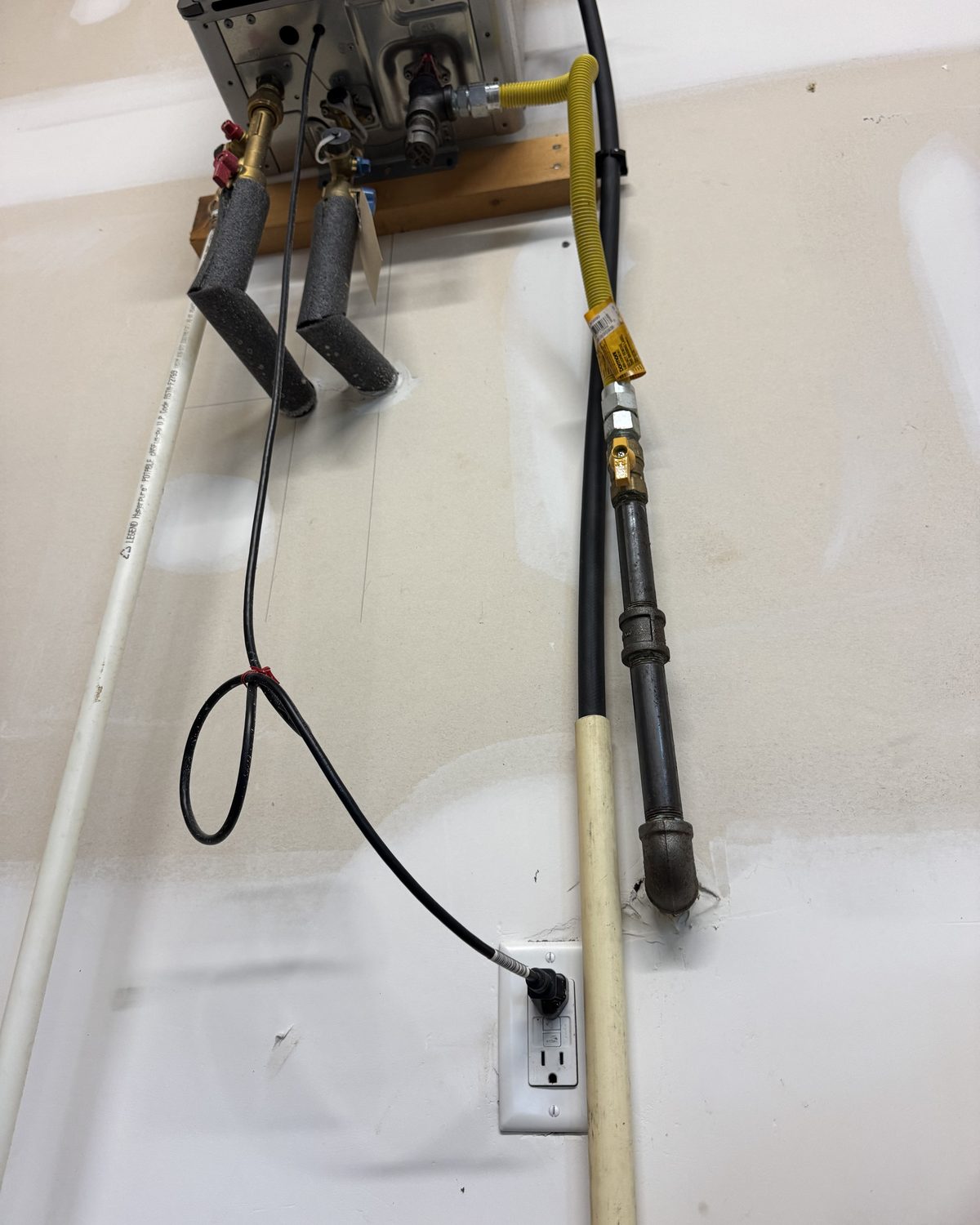
Natural gas or propane
Homes on a natural gas line usually use natural gas. Many homes farther out, where gas lines do not reach, use propane from a tank on the property.
The fuel changes running costs. In two real installs of the same model, the EnergyGuide labels estimate $228 a year on natural gas and $552 on propane. Those labels use national average prices, so your actual cost depends on local rates.
What a gas installation needs
- A gas line large enough for the unit. Whole-home units can use several times more gas at full output than a typical tank, so the line is often upsized.
- For propane, a regulator and tank that can keep up with the demand. Your propane supplier may need to weigh in.
- Venting to the outside, in the pipe material the manufacturer requires for that model.
- A shutoff valve and a sediment trap, sometimes called a drip leg, at the unit.
- A nearby outlet, because gas units need electricity for their controls and fan.
You can see each of these in the installs gallery.
Condensing or non-condensing
Condensing units capture extra heat from the exhaust, run more efficiently, and can often use manufacturer-approved plastic venting, but they need a condensate drain. Non-condensing units usually cost less up front and need venting rated for hotter exhaust. Compare the two.
Gas work needs the right license
In Virginia, gas piping falls under the gas fitting (GFC) classification, which plumbing and HVAC licenses don't cover. Make sure your contractor holds it, or uses a licensed gas fitter for that part of the job. How to check a license.
Who supplies natural gas around Richmond
Richmond Gas Works, run by the City of Richmond's Department of Public Utilities, serves the city, Henrico County, and portions of Chesterfield and Hanover. Other parts of the area are served by a different gas utility, and many homes farther out have no natural gas service at all, which is where propane comes in. If you're not sure gas reaches your street, your utility can tell you. In some homes, a large gas unit also means the utility has to upgrade the meter or service line, which can add lead time, so ask your contractor to check early.
How much hot water a gas unit can deliver
Flow depends on how much the unit has to warm the incoming water. A large residential gas unit, rated at about 199,000 BTU per hour, can deliver roughly 5 gallons per minute when it has to raise the water 70 degrees, and more when the incoming water is warmer. A typical shower head uses up to 2.5 gallons per minute. That's why one properly sized gas unit can usually run two showers at once, while a smaller unit may not. Ask your contractor for the unit's flow at a winter temperature rise, not just its maximum flow.
Propane: plan with your supplier
Propane tankless units are either built for propane or converted with the manufacturer's kit. A unit set up for natural gas should never run on propane, or the reverse, without the proper conversion. Your propane tank and regulator also have to keep up with a high-demand appliance, especially in cold weather, so loop in your propane supplier before the install.
What commonly goes wrong on gas installs
- A gas line sized for the old tank, not the new unit. The unit starves for gas and shuts down or runs lukewarm when several fixtures are on.
- The wrong gas type set on the unit.
- A missing sediment trap at the unit.
- Vent runs past the manual's length or elbow limits, or vent terminations too close to windows, doors, or air intakes.
- No plan for where a condensing unit's condensate drain goes.
Cost, and when gas tankless may not fit
As a national reference, Angi's 2026 cost data puts a typical tankless installation at about $1,400 to $3,900. Gas conversions that need a new line and new venting often land higher. If your home has no gas service and you don't want a propane tank, or the gas line would have to run a long way, an electric tankless unit or a heat pump water heater may be worth comparing. See electric tankless water heaters.
Gas tankless questions
Is natural gas or propane cheaper to run?
Natural gas usually is. In the installs gallery, the same model's EnergyGuide label estimates $228 a year on natural gas and $552 on propane, based on national average fuel prices. Local rates and your household's use change the real numbers.
Does a gas tankless water heater work without power?
No. Gas units need electricity for their controls, fan, and ignition. Some homeowners add a battery backup or a generator connection.
Can a natural gas unit be converted to propane?
Some models can, using the manufacturer's conversion kit installed by a licensed technician. Others are built for one fuel only. Check the model before you buy.
Is there still a federal tax credit for gas tankless?
The federal Energy Efficient Home Improvement Credit, which covered qualifying gas tankless water heaters, ended for equipment placed in service after December 31, 2025. Ask your tax preparer, and ask your contractor about any current utility rebates.
How we help
Call or send a short request and tell us about your home. We connect you with one independent, licensed contractor who serves your area. They evaluate your home and give you a quote, and you decide. There's no charge for the referral.
Want a licensed contractor to look at your home?
Call or send a short request. There's no charge for the referral.