
Rinnai Tankless Water Heaters in Richmond, VA
Rinnai is one of the most common tankless brands in Richmond-area homes. Here's how today's Rinnai tankless water heaters differ, what to know about recirculation, venting, warranty registration and flushing, and how to get an independent, licensed contractor to install or repair one.
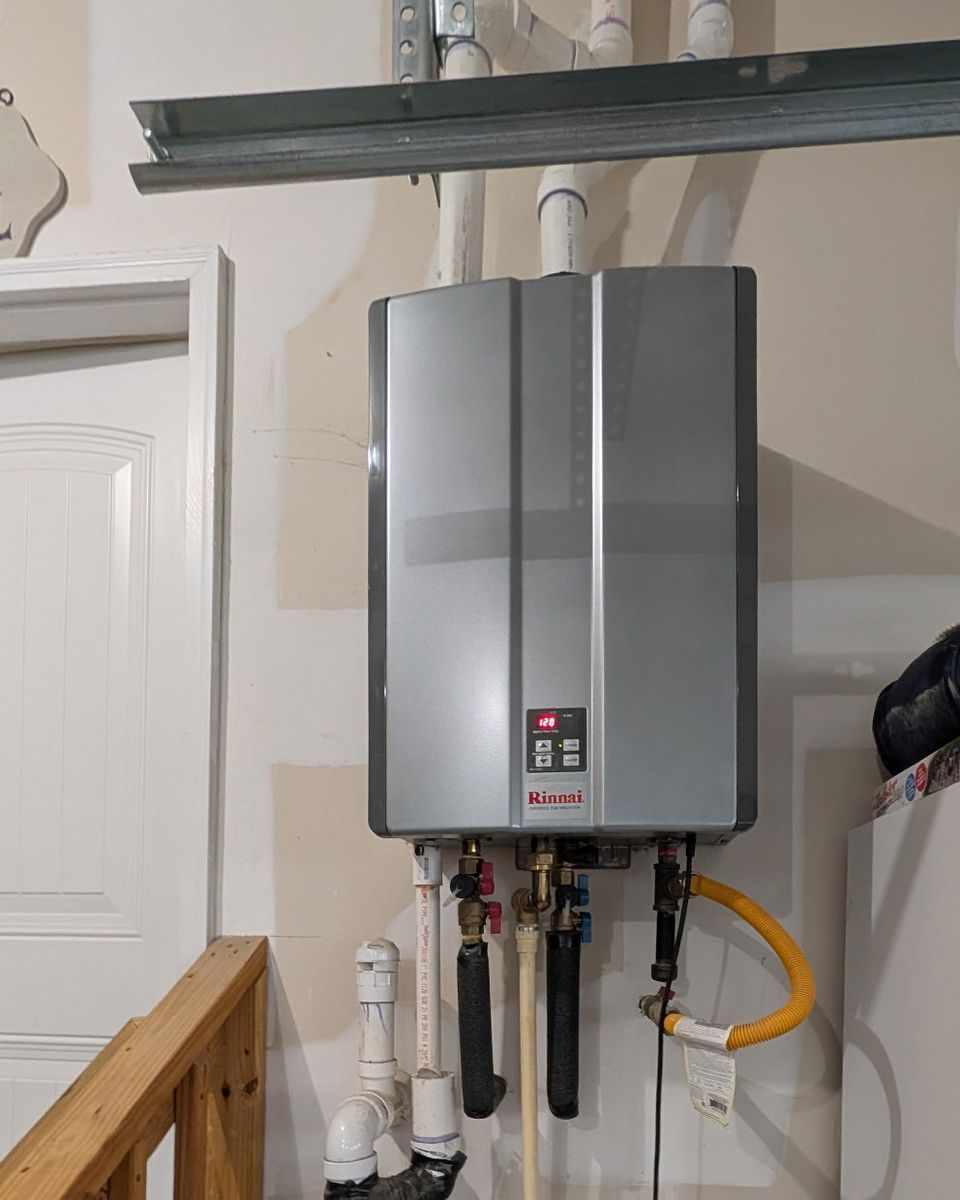
Today's Rinnai lineup, in plain terms
Rinnai sorts its home tankless water heaters into condensing and non-condensing models. Condensing units pull extra heat out of the exhaust and vent through plastic pipe. Non-condensing units usually cost less up front and need venting rated for hotter exhaust.
- SENSEI RX: condensing, in sizes up to 199,000 BTU per hour. One RX unit can run on natural gas or propane without a conversion kit.
- SENSEI RXP: the RX with a recirculation pump built in.
- RE: non-condensing, in indoor and outdoor versions, sold separately for natural gas or propane.
- REP: the RE with a built-in pump. Rinnai describes it as the first non-condensing tankless unit with one.
- V series: non-condensing units that mount outdoors.
- RUS and RUCS: smaller condensing units, for outdoor (RUS) or indoor (RUCS) installs.
In a Rinnai model number, "i" means indoor and "e" means outdoor, and on most models "N" means natural gas and "P" means propane. Older Rinnai units, like the RL94i in our installs gallery and the earlier SENSEI RU and RUR models, are still in service in plenty of homes.
Built-in recirculation
Rinnai calls its recirculation feature Smart-Circ. It's built into RXP and REP models, and an RX can add it with Rinnai's pump kit. The pump keeps hot water close to your faucets, so you wait less for it.
With a dedicated return line, the pump loops hot water back to the heater. Without one, a thermal bypass valve goes at the fixture farthest from the heater, and the system uses the cold water line as the return. Smart-Circ learns when your household uses hot water and schedules recirculation around it, and an optional push button starts it on demand.
Recirculation does cost energy. ENERGY STAR notes that systems that run continuously can use more energy than they save, which is why scheduled or on-demand recirculation fits most homes better.
Venting and placement
A condensing SENSEI RX vents through 2-inch PVC, CPVC or polypropylene pipe for up to 75 feet, 3-inch pipe for up to 150 feet, or a concentric vent that takes in air and sends out exhaust through one wall opening. Indoor RE and REP units use Rinnai's 3-inch by 5-inch concentric vent. Outdoor models mount on an outside wall, and an RX can go outside with Rinnai's outdoor vent cap.
Vent runs past the manual's length or elbow limits are a common install mistake, so ask your contractor how the vent will run for your exact model. Condensing units also need a drain for their condensate.
Warranty: register within 90 days
Rinnai's current residential warranty for its SENSEI models covers the heat exchanger for 15 years or 12,000 operating hours, whichever comes first, and parts for 5 years. Labor is covered for 5 years if the unit is registered with Rinnai within 90 days, and for 1 year if it isn't. Ask your contractor to register it, or register it yourself, the week it's installed. Terms differ by series, so check the warranty for your model.
The warranty doesn't cover damage from scale, freezing or poor water quality, and Rinnai warns that improper installation may void it. Rinnai also says the warranty isn't valid on a unit bought from an unauthorized seller, so it's fair to ask where your contractor buys Rinnai equipment.
Keeping a Rinnai running on Richmond water
Rinnai says to flush the heat exchanger at least once a year with undiluted white vinegar, never a chemical descaler, and to keep the inlet water filter clean. Most public water around Richmond is soft. Chesterfield County describes its water as about 40 to 70 parts per million, and the City listed 64 parts per million in its 2019 water quality report. Both are well under the 200 milligrams per liter hardness limit in Rinnai's manuals. If your home is on a private well, have the water tested, since well water varies. How flushing works.
If your Rinnai shows LC on its display, that's its scale warning. Rinnai says it's the only code that lets the unit keep running, but it means a flush is overdue.
Common Rinnai error codes
- 10: air supply or exhaust blockage. On SENSEI condensing units, a blocked condensate line can cause it too.
- 11: no ignition.
- 12: flame failure.
- LC: scale buildup in the heat exchanger.
Write down the code and your model number before you call. The repair page covers other symptoms and what's safe to check yourself.
Rinnai training and Virginia licenses
Rinnai runs a member program for contractors, the Rinnai PRO Network, and a Find a Rinnai PRO locator on its website. Manufacturer training is a good sign, but it isn't a Virginia license. Whoever installs your Rinnai should hold the right state license for the plumbing and gas work. Ask whether they're a Rinnai PRO, then check their license in two minutes.
Rinnai questions
Why does my Rinnai shower go hot, then cold?
Common causes are a flow rate close to the unit's minimum (Rinnai lists a minimum activation flow of about 0.4 gallons per minute), scale in the heat exchanger, a problem in the shower valve, or a unit too small for a winter temperature rise. A technician can read the unit's error history and check the flow.
Why does hot water take a while to reach my faucet?
The heater fires within seconds, but hot water still has to travel through the pipes, so the wait depends mostly on distance. Smart-Circ recirculation or a push-button pump shortens it.
Can one Rinnai run two showers at once?
Usually, if it's sized for it. The largest SENSEI RX models are rated up to 11.1 gallons per minute when the water needs only a small temperature rise. In winter, when incoming water is colder, every tankless unit delivers less, so ask for the model's flow at a winter rise.
Can I switch my Rinnai from propane to natural gas?
It depends on the model. A SENSEI RX can run on either fuel without a conversion kit. RE, REP and V models come in separate natural gas and propane versions, so check the model number and have a licensed technician handle any change of fuel.
Can I control a Rinnai from my phone?
SENSEI RX units connect to the Rinnai Central app over Bluetooth for setup and registration. Changing settings from anywhere takes Rinnai's Wi-Fi module, which is sold separately.
How we help
Call or send a short request and tell us about your home, including your Rinnai's model number if you already have one. We connect you with one independent, licensed contractor who serves your area. They evaluate your home and give you a quote, and you decide. There's no charge for the referral. RichmondTankless.com isn't affiliated with Rinnai.
Want a licensed contractor to look at your home?
Call or send a short request. There's no charge for the referral.