
Tankless Water Heater Installation in Richmond, VA
Installing a tankless water heater in a Richmond-area home means mounting the unit, connecting water and fuel, and venting it safely, and the details depend on your house. Here's what the job involves, what changes the price, and how to get a licensed local contractor to look at yours.
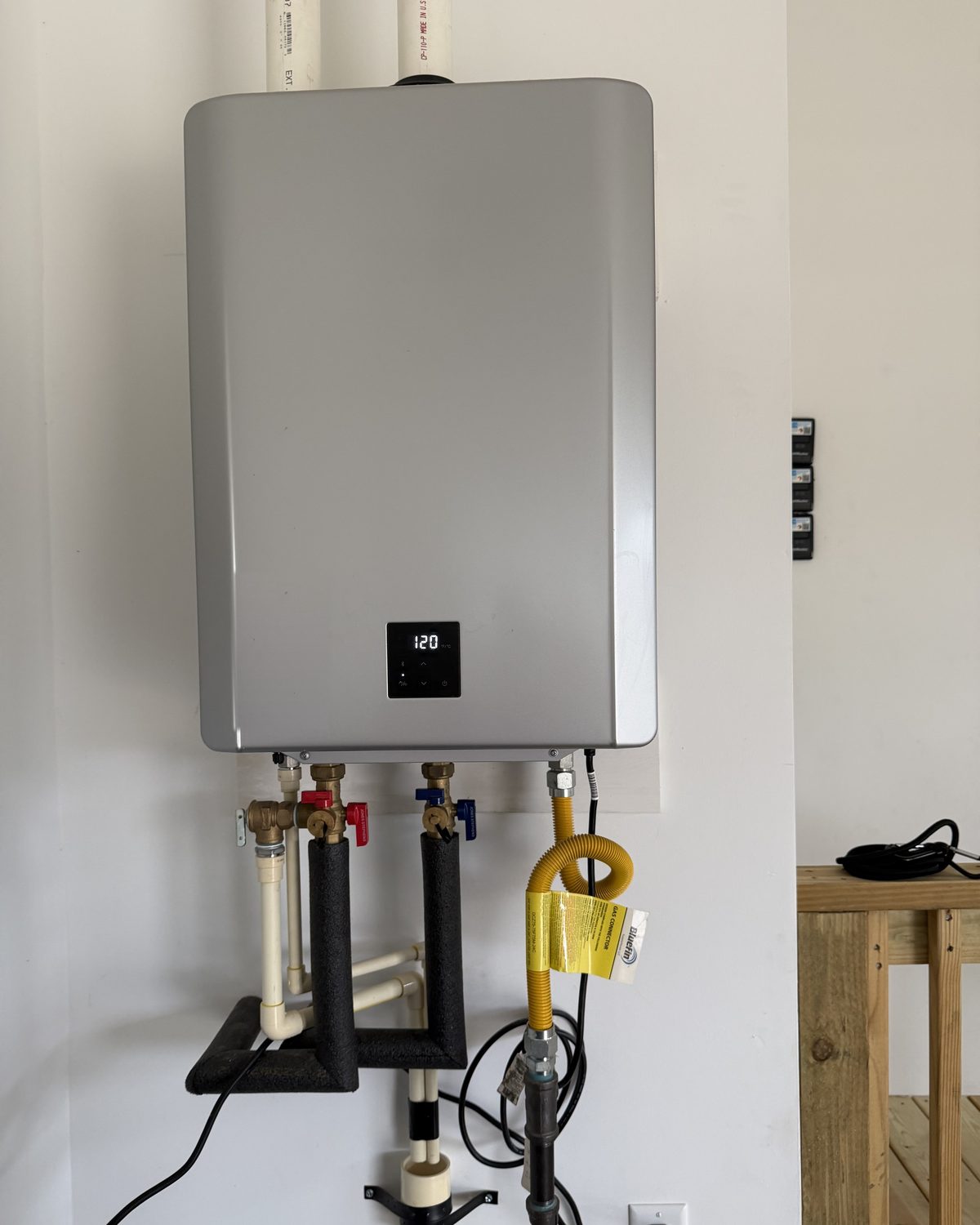
What an installation involves
A licensed contractor typically handles these steps:
- Mounting the unit on a wall, indoors or outdoors depending on the model.
- Connecting the hot and cold water lines, usually with service valves so the unit can be flushed later.
- Running a gas line sized for the unit, or adding electrical circuits for an electric model.
- Venting a gas unit to the outside through a wall or roof, using the pipe material the manufacturer requires.
- Adding a condensate drain for condensing models.
- Installing a pressure relief valve, then starting up and testing the system.
Replacing a tank is a bigger job than it looks
Swapping a tank water heater for a tankless one is a conversion, and conversions usually take more work than a like-for-like replacement. A whole-home gas tankless unit can burn several times more gas at full output than a typical tank, so the gas line often needs to be larger. The old tank's vent usually can't be reused. Gas units also need a nearby outlet for their controls, and electric units can need a panel upgrade. Your contractor should check all of this before quoting.
Getting the size right
Tankless units are sized by flow, not by the size of your house. The question is how many gallons per minute of hot water your household uses at the same time, and how much the unit has to raise the water's temperature. Incoming water is colder in winter, so an undersized unit that keeps up in July can fall short in January. Ask your contractor how they sized the unit for your household.
What affects the price
Installed cost depends far more on your house than on the unit itself: the fuel, whether it is a conversion, gas line and venting work, electrical upgrades, where the unit mounts, and permits. See what drives the cost.
As a national reference point, Angi's 2026 cost data puts a typical tankless installation at about $1,400 to $3,900, with an average around $2,600. Conversions from a tank often land higher, because a larger gas line, new venting, electrical work, and removing the old heater are added on top. Those are national figures, not Richmond quotes. The written quote from a contractor who has seen your home is the number that counts.
Licensing and permits
In Virginia, anyone who contracts for home improvement work over $1,000 needs a contractor license, and the license has to cover every part of the job, including gas piping and electrical work. Permit requirements vary by city and county; the contractor should find out what is required and pull any permits. Who installs tankless water heaters in Richmond explains how to check a license in two minutes.
Where the unit can go
Tankless units fit spots a tank can't, but each location brings its own questions:
- Garage: a common choice in Richmond-area homes, as the installs gallery shows. Easy to vent and service, but an unheated garage relies on the unit's freeze protection, which needs power.
- Basement or utility room: often close to the old tank's water and gas lines, which can keep the job simpler.
- Crawlspace: possible, but ask about access for flushing and repairs, where the vents and condensate will go, and freeze protection.
- Outside wall: outdoor-rated models skip interior venting, but they need a plan for hard freezes and power outages.
- Attic: rarely the first choice. It's hard to reach for service, and a leak can damage the ceilings below, so ask how a leak would be caught, such as with a drain pan.
Recirculation: hot water sooner
A tankless unit heats water within seconds, but the water still has to travel to the faucet. Recirculation shortens that wait by keeping hot water moving through the pipes. Some tankless models have a built-in recirculation pump. Others work with a separate pump, either on a dedicated return line or with a crossover valve under the farthest sink. Recirculation uses some extra energy, so many systems run on a timer or on demand. If long waits at a far bathroom bother your household, ask about it during the quote.
What commonly goes wrong on installs
Many tankless complaints trace back to the installation, not the unit:
- An undersized gas line. The unit starves for gas when several fixtures run, then shuts down or runs lukewarm.
- No service valves. Without them the unit is hard to flush, and scale builds up.
- Vent runs that are too long or have too many elbows. Every model's manual sets limits, and going past them can cause error codes and shutdowns.
- Reusing the old tank's vent. Tankless units need venting approved for that specific model.
- Sizing for summer. A unit that keeps up in July can fall short in January.
- A condensate drain with nowhere good to go. Condensing units make slightly acidic water that needs a proper drain, and a neutralizer is often recommended.
- A warranty that never gets registered. Some brands extend coverage only when the unit is registered.
When a tank may be the better choice
Tankless isn't right for every home. A new tank may make more sense if your gas line, venting, and electrical service would all need major upgrades, if you plan to move before the energy savings add up, or if your household regularly runs more hot water at once than one practical unit can deliver. A good contractor will tell you if that's your situation. Is tankless right for your home?
Installation questions
Do I need a bigger gas line?
Often, for a whole-home gas unit. A large residential tankless unit can burn up to about 199,000 BTU per hour at full output, compared with roughly 40,000 for a typical gas tank, so the line that fed your tank is frequently too small. Your contractor should check the line's size and length before quoting. More on gas tankless.
Will I have hot water during a power outage?
Not without backup power. Gas tankless units need electricity for their controls, fan, and ignition, and electric units need it to heat. If outages are common where you live, ask about a battery backup or a generator connection.
Is there still a federal tax credit for a tankless water heater?
The federal Energy Efficient Home Improvement Credit, which covered qualifying gas tankless water heaters, ended for equipment placed in service after December 31, 2025. Ask your tax preparer about your situation, and ask your contractor whether any utility rebates are available.
How long does installation take?
A straightforward replacement is often done in a day. A conversion from a tank that needs a new gas line, venting, or electrical work can take longer, especially when a permit inspection is involved.
How we help
Call or send a short request and tell us about your home. We connect you with one independent, licensed contractor who serves your area. They evaluate your home and give you a quote, and you decide. There's no charge for the referral.
Want a licensed contractor to look at your home?
Call or send a short request. There's no charge for the referral.